Most fabric is made the opposite way round from Patola — and understanding that difference is the fastest way to understand why Patola is unlike anything else.
Normal fabric: design comes last
With most clothing, the process is straightforward: the fabric is woven first, plain, and only afterward does it get pleated, embroidered, or otherwise worked on. Design is something added on top of a finished cloth.
Patola: design comes first — encoded directly into the thread
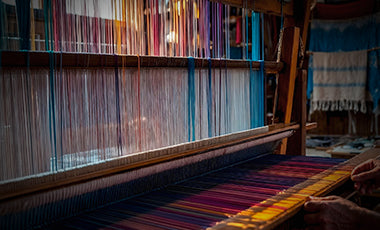
Patola inverts that entirely. The colors and design are planned onto the thread before any weaving happens at all. Both the warp and the weft are dyed with the exact same design in advance, so that when they finally come together on the loom, the same color lands in the same place from both directions — set, precisely, by design rather than chance.
It starts with a graph
When a customer places an order, the very first step isn't dyeing or weaving — it's a full design graph. That graph determines exactly how many sections (khanas) the saree needs.
In the example our weaving partner showed, a single saree's design broke down into 31 distinct parts, moving section by section down its length. Each of those sections can require anywhere from 100 to 300 individual pure silk threads, depending entirely on how complex that part of the design is.
And still — only silk
As with every stage of this craft, the material never changes: pure silk, and nothing else.
Why this matters
By the time a Patola saree reaches the loom, most of the real intellectual work — the planning, the mapping, the precision — is already done.
The weaving itself is simply the execution of a plan that was calculated thread by thread, section by section, before the first dye ever touched the silk.