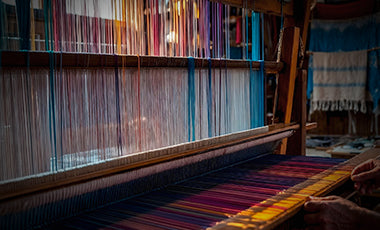
Some of the smallest details on a saree take the most patient hands to make. This is one of them.
Watching a booti — a small woven zari motif — come together, our weaving partner walked through the process directly on the loom. The motif is built in raised layers, worked back and forth across the fabric one pass at a time. A single small booti pattern can involve as many as 15 individual tilli (weaving sticks), each one used to place the zari thread precisely, one small section at a time, until the raised motif fully emerges from the base cloth.
The zari itself sits woven directly into the fabric — not applied on top afterward — with the underlying cloth structured to hold it firmly in place, finishing clean and secure.
Why this matters
It's easy to glance at a small zari motif and assume it's a minor detail. In reality, something as small as a single booti can represent 15 separate passes of careful, manual work — a reminder that even the smallest elements of a handloom saree carry real time and skill, not just the large, obvious patterns.