A conversation with Bharat Kantilal Salvi, Patan, Gujarat
There is a temple bell ringing somewhere in the background when Bharat Kantilal Salvi begins to speak. It feels appropriate — what he's about to describe is closer to devotion than trade.
"My family has worked here for 900 years," he says. "Since the 11th century." Back then, the king of Patan invited 700 weaving families to settle in the region and create textiles for daily worship. Over the centuries, one by one, those families moved on, took up other work, or simply stopped. Today, only one family in Patan still practices traditional natural-dye Patola weaving the original way. His.
Bharat is 72. He has been weaving for 55 years. He is, by his own account, still running.
A design with no printing — because none is possible
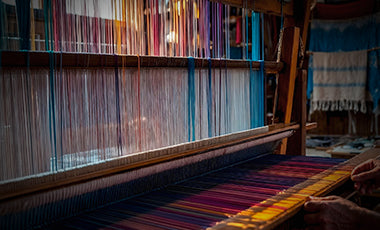
The first thing to understand about Patola is what it isn't: it isn't printed. The entire design — every motif, every color placement — is committed to the thread itself before a single pass of the loom happens.
Both the warp and weft threads are individually tie-dyed in advance, with such precision that when they are finally woven together, the pattern simply appears, dana by dana, exactly where it was always meant to be.
This is double ikat — one of the most demanding textile techniques in the world — and Patan Patola is among the last places on earth still practicing it entirely by hand.
Months of work, thread by thread
The process starts with silk finer than a human hair. Eight such threads are combined for thickness, twisted, and prepared.
Then comes the dyeing — but not once. A single saree can require five separate rounds of tying, dyeing, and untying, each one adding another color to the eventual design, with the untouched (tied) sections carefully protected so the color goes only where it belongs.
One saree takes four artisans between four and six months to complete. Prices start at ₹1.5 lakh and rise from there, depending on the complexity of the design.
Why It Can Never Be Replaced by a Machine
Bharat is unambiguous on this point: Patola cannot be replicated — not by digital printing, not by power loom, not by any shortcut. "This work will only happen on handloom," he says.
"It will move forward. It will be done manually." When Japanese textile professors invited him and his brother to Japan for a 15-day live demonstration in 2000 and asked whether the technique could be attempted by computer, the answer they gave was simple: this exists without geometry, without formal measurement. It was refined by centuries of practice — a "god's gift by practice," in his words — not by calculation.
There's a centuries-old Gujarati wedding folk song that captures just how prized Patola always was: a bride asks her husband to bring her a costly Patola from Patan — the same impression appearing identically on both sides of the fabric.
Even in 1936, when a Patola sold for what was then a princely ₹1, it was already understood as the expensive choice. It has never been anything else.
There's also a piece of household wisdom that comes with it: wash a Patola yourself, at home, and — as the Gujarati saying goes — "padat pol, baad aatle par pitte" — the true color only sets once the fabric itself begins to fade. The design and the dye are made to last generations, not seasons. Patola sarees are, quite literally, meant to be passed from grandmother to granddaughter.
A legacy recognized at the national level
Bharat's brother received a National Award during Dr. A.P.J. Abdul Kalam's presidency, presented by then-Prime Minister Vajpayee, with the Shilp Guru title following.
For that recognition, the family created an entirely new piece — reviving a 150-year-old design that had, until then, existed only in four or five surviving fragments scattered across foreign museums.
It took three years to bring it back, with no design repeated across the entire piece. That work won the Gandhi Silk Master Cloth Award.
Visitors have included delegations from the G20 and, in an earlier era, Dr. Rajendra Prasad, India's first President.
What we're really buying, when we buy handloom
It's easy to talk about "heritage" as a marketing word. It's harder to sit with what it actually means: a single family, unbroken, for 900 years, doing work that a room full of the world's best engineers agreed could not be replicated by any machine.
That's not a claim we're making about our sarees. It's a fact about the tradition they come from.